
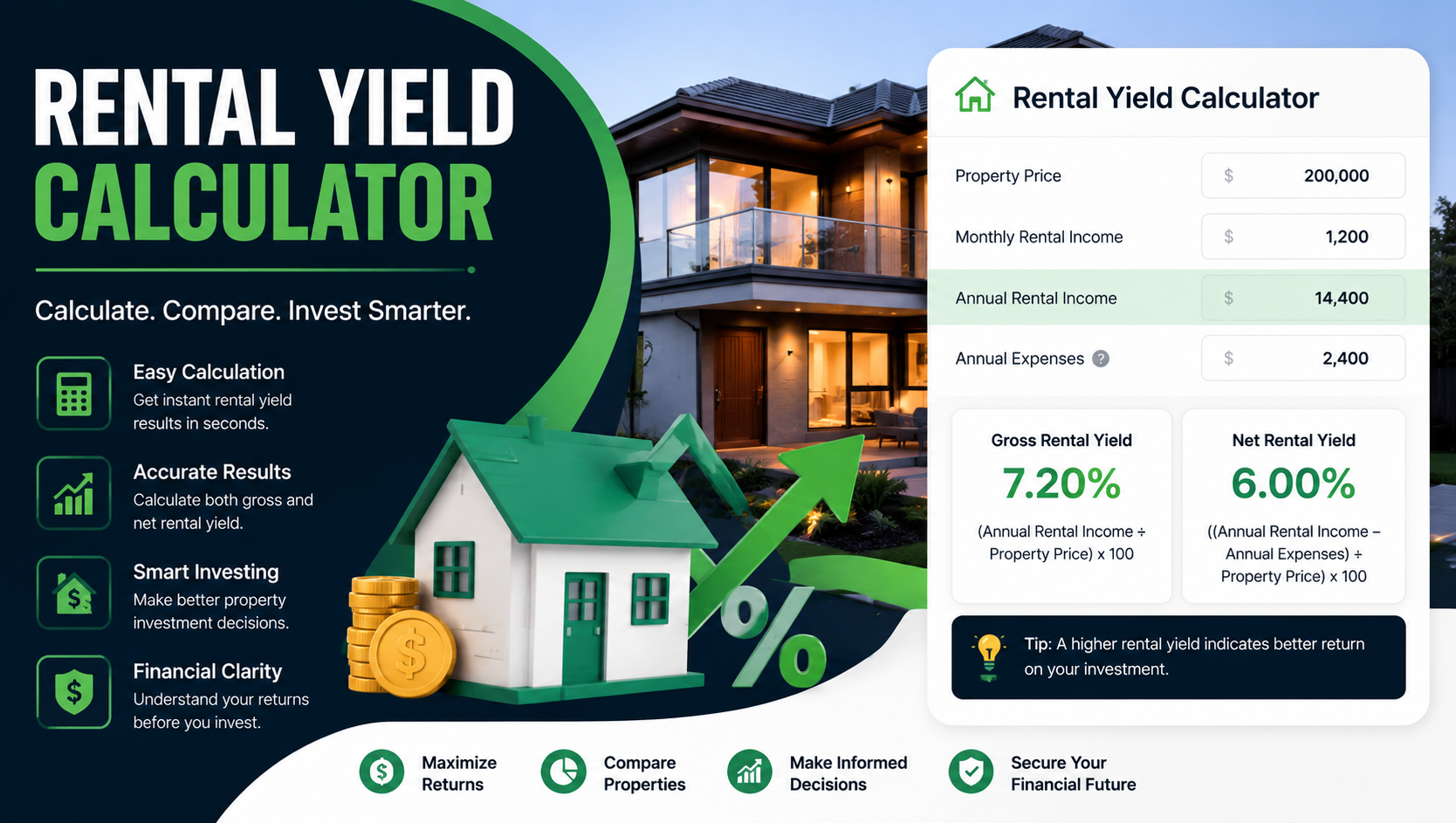
Talk to anyone who’s been investing in property for a while, and sooner or later they’ll bring up rental yield. It’s almost a rite of passage. And the tool that makes this whole concept click for beginners is the rental yield calculator—nothing fancy, just a way of turning “I think this property is a good deal” into “here’s the actual number that proves it.”
I’ll be honest, when you’re new to this, it’s really tempting to fall for a place because of the way it looks. Maybe the kitchen is gorgeous; maybe the street feels right, maybe the agent just said all the right things. None of that matters to a rental yield calculator. It doesn’t care about vibes. It just wants two numbers , what the property costs and what it earns, and from there it tells you the truth. So let’s actually get into it: what a rental yield calculator is, why people rely on it so heavily, and how you can start using one without needing a finance degree.
Visit Now: https://rentcalcpro.com/
What Is a Rental Yield Calculator, Really?
Strip away the jargon and a rental yield calculator is just a tool that works out the percentage return you’d get from renting out a property, based on how much it costs versus how much rent it brings in. Sometimes it’s a slick app. Sometimes it’s just a spreadsheet somebody built years ago and never bothered to fancy up. Either way, it does the same job , it saves you from pulling out a calculator and redoing this math every single time a new listing catches your eye.
Think of it as your reality check button. You walk into a property, you like the layout, maybe you picture yourself living there even though you’re not planning to. That’s exactly the moment a rental yield calculator earns its keep , because it pulls you back to the numbers instead of the feelings. And in property investing, feelings have burned a lot of people. Numbers, at least, don’t lie to you.
Why Rental Yield Is Worth Caring About?
Before we go further into the mechanics of a rental yield calculator, it helps to understand why this number is such a big deal in the first place.
When people put money into property, they’re usually chasing two different rewards. One is capital growth , basically hoping the property is worth more down the line. The other is rental yield , the actual income you collect from having tenants in there. Capital growth sounds great on paper, but it’s a bit of a gamble. You might wait five years and see nothing. You might get lucky and see a huge jump. Nobody really knows. Rental yield doesn’t have that uncertainty baked in. You can measure it right now, today, before you’ve even signed anything, which is exactly why a rental yield calculator is so valuable , it deals in the present, not in hopeful predictions.
This is also why plenty of experienced investors basically refuse to look seriously at a property until they’ve run it through a rental yield calculator. It levels the playing field. A $500,000 property isn’t automatically a smarter buy than a $250,000 one , not if the cheaper place is actually earning more relative to what it cost.
Gross Yield, Net Yield, and Why the Difference Actually Matters
Here’s something that trips up almost every beginner the first time they touch a rental yield calculator: there isn’t just one version of this number. There are two, and they tell very different stories.
Gross rental yield is the easy one. You take the annual rent, divide it by the property price, and that’s it , no expenses, no complications. Most free rental yield calculator tools you’ll find online default to this because, well, it’s the fastest number to spit out.
Net rental yield takes a bit more effort but gives you something much closer to the truth. It starts the same way, but then subtracts the actual running costs , maintenance, insurance, management fees, taxes, the odd stretch where the place sits empty , before comparing that number to the price. Any decent rental yield calculator should let you toggle between the two, because honestly, the net figure is the one that tells you what you’re really walking away with.
If you’re the type who only glances at the gross number because it looks nicer, just keep in mind , the real return is basically always a bit smaller once you factor everything else in.
Read More: Roommate Agreements: What to Include and Why
Doing the Math Yourself (Yes, By Hand)
A rental yield calculator will do this for you in a second, but it’s still worth knowing what’s happening under the hood. Otherwise you’re just trusting a black box.
| Calculation | Formula | Example | Result |
|---|---|---|---|
| Gross Rental Yield | (Annual Rental Income ÷ Property Price) × 100 | ($14,400 ÷ $200,000) × 100 | 7.2% |
| Net Rental Yield | ((Annual Rental Income − Annual Expenses) ÷ Property Price) × 100 | (($14,400 − $2,400) ÷ $200,000) × 100 | 6.0% |
Example Values
| Item | Amount |
|---|---|
| Property Price | $200,000 |
| Monthly Rental Income | $1,200 |
| Annual Rental Income | $14,400 |
| Annual Expenses | $2,400 |
| Gross Rental Yield | 7.2% |
| Net Rental Yield | 6.0% |
How Does a Rental Yield Calculator Actually Work?
Most tools ask for roughly the same handful of inputs:
- Purchase price, or current market value if you already own the place
- Rental income, either monthly or annual
- Ongoing costs, if you want the net figure , things like taxes, insurance, upkeep, management fees, and some allowance for vacancy
Feed it those numbers and the rental yield calculator spits back a percentage almost instantly. That percentage is basically your report card , how well this property performs purely as a rental investment.
Some of the more thorough versions go a step further and let you factor in your mortgage repayments too, giving you what people call a cash-on-cash return. This one’s actually pretty important because most beginners aren’t paying cash upfront , they’re borrowing, and once loan repayments enter the picture, the real return can look noticeably different from the raw yield number.
Why Beginners in Particular Shouldn’t Skip This Step
I get it, math isn’t always the fun part of buying a property. But skipping the rental yield calculator step is one of those shortcuts that tends to cost people later.
For one, it takes the emotion out of the equation. New investors fall in love with places for reasons that have nothing to do with return , a nice view, a trendy neighborhood, whatever. A rental yield calculator drags you back to reality.
So What’s Actually a Good Yield?
This is usually the very next question once someone’s run their first few properties through a rental yield calculator. Is 6% good? Is 4% bad? It depends, honestly.
As a loose rule of thumb, something in the 5% to 8% range is generally considered solid for residential property, though this shifts a lot depending on where you’re looking. City-center properties, the kind everyone wants to live in, often show lower yields , sometimes down around 3% or 4% , simply because the purchase price is so high compared to what rent actually brings in. Meanwhile, properties out in smaller towns, or areas that are still catching up in popularity, can show yields of 8%, 9%, even into double digits, because prices haven’t caught up with rental demand yet.
This is another reason the rental yield calculator is such a useful habit to build , it lets you set your own local benchmark rather than chasing some universal “good number” that doesn’t really exist. What counts as good in one city might be mediocre in another. Context is everything here.
Before You Even Open the Calculator
Getting a trustworthy number out of a rental yield calculator depends entirely on what you feed into it. Garbage in, garbage out, as the old saying goes. A few things worth sorting out first:
- Get a realistic rent figure. Don’t just guess based on what you’d like it to rent for , look at what comparable places nearby are actually charging.
- Know your true purchase cost. That’s not just the sticker price. Add in closing costs, legal fees, and whatever renovation work needs doing before a tenant could even move in.
- Don’t forget ongoing expenses. Taxes, insurance, maintenance reserves, management fees if you’re using an agent , all of this needs to go into your net calculation.
- And build in a vacancy buffer. No property stays rented every single day of every year. A good rental yield calculator lets you account for this, usually somewhere around 5% to 10% of annual rent, just to keep your expectations grounded.
The more honest your inputs, the more useful the output. It sounds obvious, but it’s the step most beginners rush through.
Mistakes That Keep Popping Up
- Even with a rental yield calculator open in front of them, beginners tend to fall into the same handful of traps.
- One is only ever looking at the gross number because it looks more impressive, while quietly ignoring what expenses will actually chew away at it.
- Another is assuming top-dollar rent without actually checking what similar places are renting for down the street.
- Then there’s forgetting vacancy altogether, as if a property will somehow stay occupied every month, forever, without exception. It won’t. Nothing does.
- Skipping mortgage costs is another big one. If you’re financing the purchase, your rental yield calculator numbers should really reflect those repayments too , otherwise the “return” you’re looking at is more of a nice theory than a real number.
- Comparing yields across wildly different markets without context is another classic mistake. A 5% yield might be genuinely excellent in one city and pretty average somewhere else.
And finally, relying on stale data. Rents move, prices move, and feeding a rental yield calculator numbers from two or three years back is basically asking for a distorted answer.
Read More: Moving Costs Budget: How to Budget for Moving Costs on Top of Rent
Pushing Your Rental Yield Higher
If you’ve already run the numbers and the yield came back disappointing, that’s not necessarily the end of the story. There’s usually room to improve it.
- Renovating with intention helps , fresh paint, a modern kitchen, small upgrades that justify charging a bit more rent. Even minor changes can nudge the number your rental yield calculator produces.
- Reducing vacancy matters too. Better tenant screening, sensible pricing, staying on top of the property instead of letting it sit , all of this keeps the place occupied more consistently.
- Negotiating a lower purchase price is one of the most direct levers you have, since yield is tied straight to what you paid. Buy below market value and the number improves instantly.
- Refinancing can help your cash-on-cash return even if the raw yield stays exactly the same, simply by lowering what you’re paying in interest.
- Adding extra income streams , parking, storage, renting furnished at a premium , can lift your total rental income without needing to touch the base rent.
- And trimming unnecessary costs, whether that’s shopping around for cheaper insurance or a more reasonably priced property manager, improves net yield without you having to raise the rent at all.
- It also makes comparing options a lot less painful. Say you’ve got three properties on your shortlist, all in different parts of town. Run each through a rental yield calculator, and within a minute you know which one is actually pulling its financial weight, regardless of which one you personally like best.
- It protects you from properties that quietly drain money for years. A weak yield isn’t always obvious just by looking at a listing , sometimes it only becomes clear once you actually run the numbers.
- And you really don’t need any special background to use one. Most rental yield calculator tools are built with total beginners in mind , plug numbers in, get an answer out.
Beyond that, once you know your expected yield, budgeting gets a whole lot easier. You can plan repayments, set expectations, and build a longer-term strategy around numbers that are grounded in reality rather than optimism.
Location Changes Everything, and I Mean Everything
Location is probably the single biggest lever affecting whatever number your rental yield calculator hands back. Two nearly identical houses, one downtown and one out in a quiet suburb, can show wildly different yields purely because of where they sit.
In pricey city centers, property values tend to climb faster than rents ever do. So even with steady tenant demand, the number your rental yield calculator produces often ends up lower , sometimes down around 3% to 4%. Investors buying in these spots are usually betting on long-term appreciation, not immediate cash flow.
Smaller towns and up-and-coming neighborhoods tell a different story most of the time. Prices haven’t caught up yet, so yields of 7%, 8%, sometimes higher, aren’t unusual at all. The tradeoff is usually slower growth in value, and sometimes a bit more turnover or vacancy risk to manage.
This is exactly why it’s worth running a few different locations through a rental yield calculator before committing to one. Don’t just chase whichever number looks biggest , think about job growth, population trends, whether rental demand in that area is actually stable. A high yield in a shrinking town isn’t automatically a better deal than a moderate yield in a city that’s clearly growing.
Different Property Types Behave Differently Too
Not every property type produces the same kind of number when you run it through a rental yield calculator, and it’s worth knowing why.
Single-family homes tend to show moderate yields, but they usually attract tenants who stick around longer, meaning steadier income and less hassle.
Apartments and condos often come out a little stronger on a rental yield calculator, mostly because the price per unit is lower than a standalone house while rent stays fairly competitive, especially in busy city areas.
Multi-family properties , duplexes, triplexes, small apartment buildings , often produce some of the best numbers, simply because you’re collecting rent from several tenants against a single purchase price.
Student housing and short-term rentals can look tempting on the surface, sometimes showing impressive figures, but they come with more moving parts , higher turnover, more active management, seasonal ups and downs that a basic calculator won’t fully capture. If you’re going this route, be realistic with your vacancy assumptions rather than assuming best-case occupancy year-round.
Knowing these differences means you won’t automatically assume a high number equals a great deal. Context matters just as much as the percentage itself.
It Gets Easier the More You Do It
Something beginners don’t really expect: your instincts genuinely sharpen the more you use a rental yield calculator. The first handful of times, you’ll probably second-guess yourself , did I miss an expense, did I use the right rent figure, that sort of thing. That’s completely normal. But the more properties you run through it, the more patterns start jumping out at you without even trying.
You’ll start noticing certain neighborhoods consistently land in a similar range, or that a particular type of property always seems to come with higher-than-expected maintenance costs. That kind of gut feeling doesn’t come from reading articles like this one , it comes from actually doing the calculations, over and over, until it stops feeling like homework.
Make it a habit to run the numbers on every property you’re seriously considering, even the ones you’re pretty sure you’ll pass on. Over time this builds a mental benchmark for your market, and that benchmark is what makes you quick and confident the moment a genuinely good deal actually shows up.
One Tool Among Several, Not the Whole Picture
A rental yield calculator is a great starting point, but it was never meant to be the only thing steering your decision. Smart investors pair it with other measures , capital growth potential, cash flow analysis, overall return on investment.
Sometimes a property shows a modest number on a rental yield calculator but sits in a location with strong appreciation potential, and in that case the lower yield might still be worth accepting for the long game. Other times a property shows a great yield but sits somewhere clearly on the decline, where falling property values could easily outweigh whatever the yield looks like today.
The point is, a rental yield calculator hands you one piece of a bigger puzzle. It works best alongside broader research, not as a replacement for it.
Choosing a Rental Yield Calculator Worth Your Time
There’s no shortage of rental yield calculator tools floating around, from free bare-bones versions to more sophisticated paid ones tied into property listing platforms. As a beginner, you honestly don’t need anything complicated. Look for something that:
- Lets you switch between gross and net figures
- Allows you to enter recurring expenses and vacancy assumptions
- Gives you a clean, easy-to-read percentage
- Ideally accounts for mortgage repayments or cash-on-cash return
Or, if you’d rather have full control, build your own in a spreadsheet using the formulas we covered earlier. It takes a bit more effort upfront, but honestly, it teaches you the mechanics far better than clicking through a ready-made tool ever could.
A Quick Reality Check Before Wrapping Up
Don’t expect a rental yield calculator to hand you some permanent, unchanging truth. Rents shift, expenses creep up over time, interest rates move, and property values go up and down depending on the market. Whatever number you get is a solid estimate for right now, not a guarantee carved into stone for the next twenty years.
Because of that, it’s worth revisiting the numbers every so often, even for properties you already own. Rerunning a rental yield calculator once a year, using updated figures, keeps you honest about how the investment is actually performing instead of coasting on assumptions from the day you bought it. Markets shift, and your understanding of a property’s real return should shift right along with them.
It’s also worth remembering that a rental yield calculator only works with what you give it. Feed it overly optimistic rent numbers or leave out smaller recurring costs, and the output will look rosier than reality actually is. Erring a little on the conservative side almost always serves you better than being overly hopeful.
Read More: Hidden Costs of Renting Australia Beyond Weekly Rent
Conclusion
Getting comfortable with a rental yield calculator is genuinely one of the smarter habits you can build early on as a property investor. It takes the emotion out of the decision and replaces it with something you can actually compare, property to property, market to market.
There’s no single “perfect” yield that applies everywhere , what counts as good depends on where you’re investing, what you’re hoping to achieve, and how much risk you’re comfortable carrying. But if you make a habit of running potential properties through a rental yield calculator, gathering honest numbers, and measuring them against realistic local benchmarks, you’ll end up making far more confident decisions than most people jumping into this for the first time.
FAQ’s
What is a rental yield calculator?
A rental yield calculator helps property investors estimate the return on a rental property by calculating both gross and net rental yield. It uses your property’s purchase price, rental income, and expenses to provide accurate results.
How do I calculate rental yield?
To calculate rental yield, divide your annual rental income by the property’s purchase price and multiply the result by 100. A rental yield calculator can perform this calculation instantly and also estimate your net rental yield after expenses.
What is the difference between gross and net rental yield?
Gross rental yield is based only on annual rental income and property price, while net rental yield subtracts annual expenses such as maintenance, insurance, taxes, and management fees. A rental yield calculator displays both values for a complete investment analysis.
Is a higher rental yield always better?
Not necessarily. A higher rental yield can indicate stronger cash flow, but you should also consider property appreciation, vacancy rates, maintenance costs, and location before making an investment decision. A rental yield calculator is one tool among many for evaluating a property.
Can I use a rental yield calculator for any property?
Yes. A rental yield calculator can be used for residential, commercial, and investment properties. Simply enter the purchase price, rental income, and annual expenses to estimate your property’s rental yield.